Currently Empty: $0.00


You don’t need another 12-step hair routine. What you need is a repeatable, low-effort habit that supports the scalp – because that’s where “hair growth” actually starts.
Organic castor oil has earned its reputation in beauty and wellness circles because it’s simple, multipurpose, and feels like a traditional remedy you can still use in a modern schedule. But it’s also thick, easy to overdo, and not a miracle bottle that overrides hormones, genetics, or heat damage.
Below is the practical, science-aware way to think about organic castor oil for hair growth – what it can do, what it can’t, and how to use it like a consistent routine (not a one-time rescue mission).
What people mean by “hair growth” (and what castor oil can influence)
A lot of products get credit for “growing hair” when they’re really helping one of these areas:
Thicker-looking hair often comes from less breakage and better lubrication of the hair shaft. A healthier scalp environment can make it easier for hair to cycle normally, especially if dryness, irritation, or product buildup are part of the problem. And improved shine and slip can make hair look fuller even before any real length changes.
Castor oil’s sweet spot is support. It can help you retain length by reducing friction and breakage, and it can support scalp comfort when used correctly. If your main issue is sudden shedding, widening part, or hormonal hair loss, it still may be useful – but it’s not a standalone answer.
Why organic castor oil is different from “just any” castor oil
“Organic” matters less as a marketing label and more as a quality filter. When you’re putting something on the scalp repeatedly, you want fewer unknowns.
Organic castor oil is typically chosen for:
Cleaner sourcing and fewer pesticide residues
More predictable ingredient simplicity (ideally 100% castor oil, no added fragrance)
Better fit for sensitive scalps that react to extra additives
That said, organic doesn’t automatically mean “better for everyone.” If you’re allergic or you apply too much, irritation and clogged follicles can still happen. Quality helps, but technique matters more.
The scalp science: why castor oil is used for growth-focused routines
Castor oil is rich in ricinoleic acid (a fatty acid that gives it its signature thickness). It’s also highly occlusive, meaning it reduces water loss from the skin and can soften dryness.
For a scalp routine, that translates into a few practical benefits:
A more moisturized scalp barrier, which can reduce the itch-scratch cycle that makes shedding worse
Better slip at the roots and along strands, which can reduce breakage from brushing and styling
A protective feel that can be helpful if you’re in air-conditioning all day, working out often, or washing frequently
What you should not expect: castor oil doesn’t “force” new follicles to appear. It doesn’t replace medical treatment for androgenetic hair loss. Think of it as an environment optimizer – especially useful when dryness, friction, and inconsistency are the real enemies.
Who usually sees the best results (and who should be cautious)
Organic castor oil for hair growth tends to work best when the problem is breakage or scalp dryness, not when the root cause is internal.
You’re a good candidate if your hair is prone to snapping at the ends, your scalp feels tight or flaky, you wash often (gym life counts), or your hair looks dull and frizzy even with conditioner. It can also be a smart add-on for protective styles, where lubrication and friction control matter.
You should be cautious if your scalp is acne-prone, you deal with seborrheic dermatitis that flares with heavy oils, or you’re already using multiple leave-in products. Castor oil’s thickness can trap dead skin and styling residue if you don’t cleanse well.
If you have eczema, psoriasis, or persistent inflammation, patch test first and consider checking with a clinician. “Natural” can still irritate.
How to use castor oil without greasy roots or buildup
The biggest mistake is applying castor oil like a lightweight serum. It’s not. The win comes from using less than you think and making it routine-friendly.
Method 1: Scalp pre-wash (most people’s best starting point)
This is the simplest approach for busy schedules because you don’t have to style around oil.
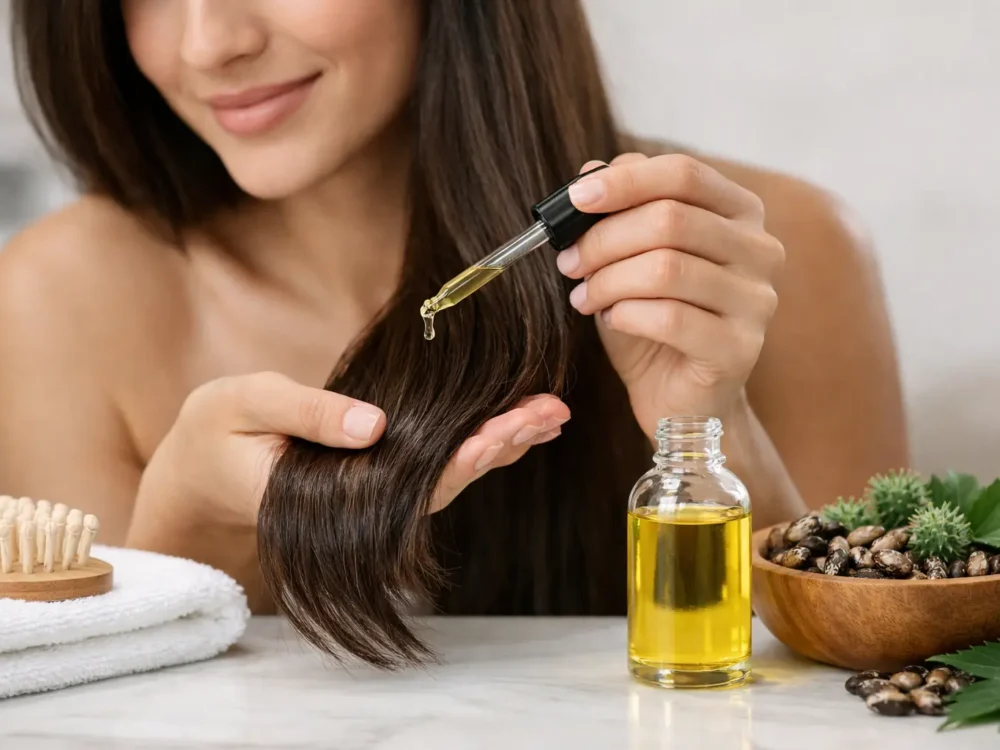
Apply a small amount to the scalp in sections, focusing on dry or itchy areas rather than flooding the entire head. Massage with fingertips for 2-3 minutes, then leave it on for 30-90 minutes before shampoo.
If your hair is fine or gets oily fast, keep it closer to 30 minutes and stay light on the roots. If your scalp is very dry, you can extend the time, but don’t treat “longer” as automatically “better.”
Method 2: Micro-dose leave-in (only if your hair tolerates it)
If you want that sleek, protected feel between washes, use a micro-dose. Think: a thin sheen on ends, not an all-over coating.
Warm a tiny amount between palms and touch only the last third of your hair. If you apply to the scalp, you’re more likely to look greasy and collect buildup.
Method 3: Castor oil blend for easier spread
Many people quit castor oil because it’s too thick. Blending makes it more workable and lowers the risk of over-application.
A common approach is to mix castor oil with a lighter oil like extra virgin coconut oil to improve spread and washability. You still get the protective feel, but you’re less likely to use half the bottle in one session.
How often to apply for growth-focused consistency
Consistency beats intensity. If you’re trying to support growth and thickness over time, aim for 1-2 times per week as a scalp pre-wash.
If you wash daily because of workouts, start once weekly and see how your scalp responds. If you wash 2-3 times per week, twice weekly can be realistic.
Track results in the right way: less shedding in the shower, less itch, less breakage during brushing, and improved softness. Actual length gains take longer because hair grows slowly. Most people need 8-12 weeks of consistent routine before they can judge whether it’s helping.
The wash-out matters more than the oil
If castor oil “doesn’t work,” it’s often because it wasn’t removed well, leading to dullness, flakes that look like dandruff, or scalp congestion.
Use a proper shampoo and focus on the scalp. If you’ve applied heavily, you may need a second lather. Avoid scraping with nails. Think massage, rinse thoroughly, and don’t leave conditioner sitting on the scalp.
If you use lots of styling products, a gentle clarifying wash occasionally can help reset the scalp so your routine stays effective.
Common mistakes that make castor oil backfire
The most common issue is using too much. Thick oil plus heat plus sweat can feel uncomfortable fast, especially in humid climates.
Another mistake is applying on an already irritated scalp without patch testing. If your scalp is red, inflamed, or actively flaking from dermatitis, heavy oils can sometimes worsen it.
Finally, don’t confuse “tingling” with “working.” Castor oil isn’t supposed to burn. If you feel stinging or see bumps, stop and reassess.
Choosing a bottle you’ll actually use consistently
For routine adoption, look for simplicity and purity cues: 100% castor oil, organic, no fragrance, and packaging that makes application easy (a secure cap and controlled pour). If you’re using it on hair, you want something you can apply in small amounts without making a mess.
If you want to keep your wellness staples in one place, Sterling Nutrition carries organic castor oil alongside other clean-label essentials so your routine stays straightforward and reorder-friendly.
The trade-off: castor oil can help growth – but only if you treat it like a system
Organic castor oil for hair growth is less about chasing a dramatic overnight transformation and more about building a scalp and strand routine you can repeat without thinking. When the scalp is comfortable and the hair breaks less, growth becomes visible.
Pick one method, keep it light, and give it enough time to prove itself. The best hair routine is the one you can do on a normal week, not just when you’re in “fix everything” mode.