Currently Empty: $0.00

You can buy “black seed oil” in two clicks. The hard part is buying the kind you actually meant – the kind with thymoquinone (TQ) you can trust, in a format you will take consistently.
If you are searching for the best black seed oil high thymoquinone, you are already ahead of most shoppers. TQ is the signature bioactive compound people are usually chasing when they add Nigella sativa to a daily routine. But here is the catch: “high TQ” is not a vibe. It is a measurable marker, and it is also fragile – meaning how the oil is made, tested, packaged, and stored can matter as much as what the label claims.
What “high thymoquinone” actually means
Thymoquinone is a naturally occurring compound found in black seed (Nigella sativa). It is widely discussed in modern wellness circles because it is one of the key constituents researchers look at when evaluating black seed’s potential effects.
When a brand says “high thymoquinone,” they are usually claiming a higher concentration of TQ than standard black seed oils. There is no single universal threshold that every regulator uses to define “high,” so you have to evaluate the claim the same way you would evaluate “high polyphenols” olive oil or “high EPA/DHA” fish oil: ask how it was measured and whether the number is backed by real testing.
Here is the practical consumer takeaway: if the label does not state a TQ amount and the brand cannot show testing that supports it, you are guessing.
Why TQ content varies so much between oils
Two black seed oils can both be “cold-pressed” and still land very differently on potency.
Seed origin and harvest timing can change the plant’s chemistry. Extraction matters too. Pressing temperature, exposure to light and oxygen during processing, and the time between pressing and bottling can all affect the final profile.
Then there is storage. TQ is sensitive. Oils that sit for long periods in warm warehouses or under bright light can degrade faster. So a “high TQ” product is not just about starting strong – it is about protecting that potency through the full supply chain.
A buyer’s checklist for the best black seed oil high thymoquinone
If you want to shop confidently, use a checklist that focuses on proof, not buzzwords.
Look for a stated TQ value and a clear test method
A real high-thymoquinone claim should include a measurable figure, typically expressed as a percentage or mg per serving, and it should be supported by batch testing.
You do not need to be a lab expert. You just want evidence that the brand is quantifying TQ rather than implying it. If a company is serious about high TQ, they tend to lead with that number because it is the differentiator.
Prioritize purity markers that reduce “unknowns”
Potency is only half the story. The best products are the ones you can take daily without questioning what else is in the bottle.
Clean-label signals that matter for black seed oil tend to include non-GMO positioning, vegan-friendly options, and manufacturing standards that limit unnecessary additives. If a softgel uses gelatin, that is not automatically “bad,” but it does matter if you are trying to keep your routine vegan.
Also pay attention to whether the product is diluted or blended. Some brands cut black seed oil with cheaper carrier oils. Blends can be fine when clearly labeled, but they complicate the potency conversation because the TQ is coming from the Nigella sativa portion only.
Packaging is part of the formula
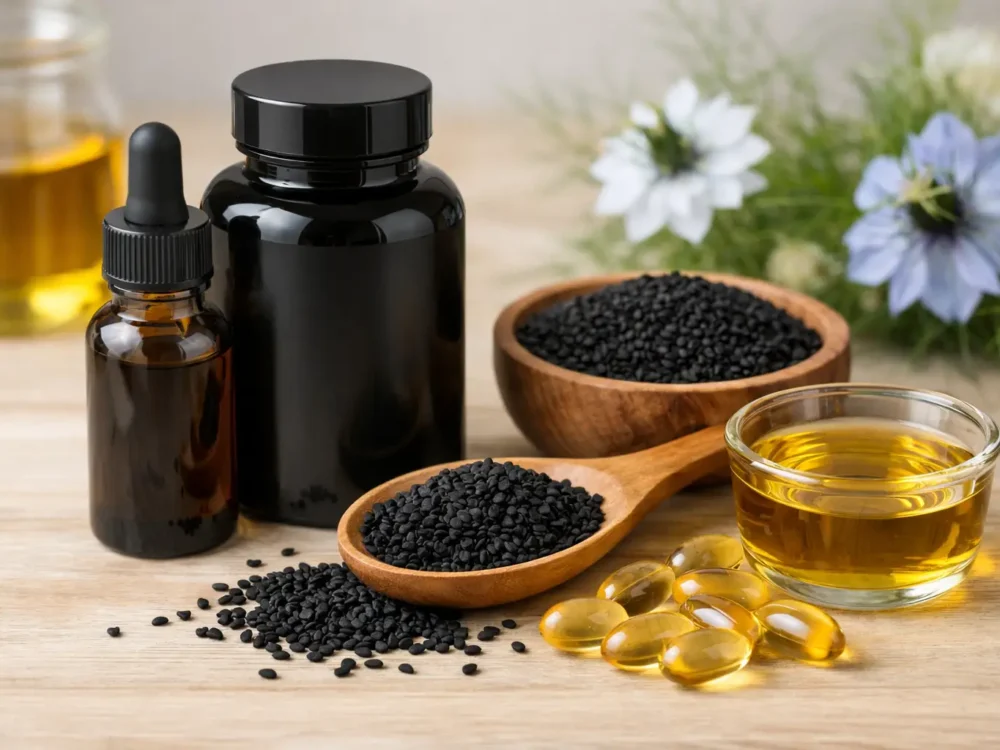
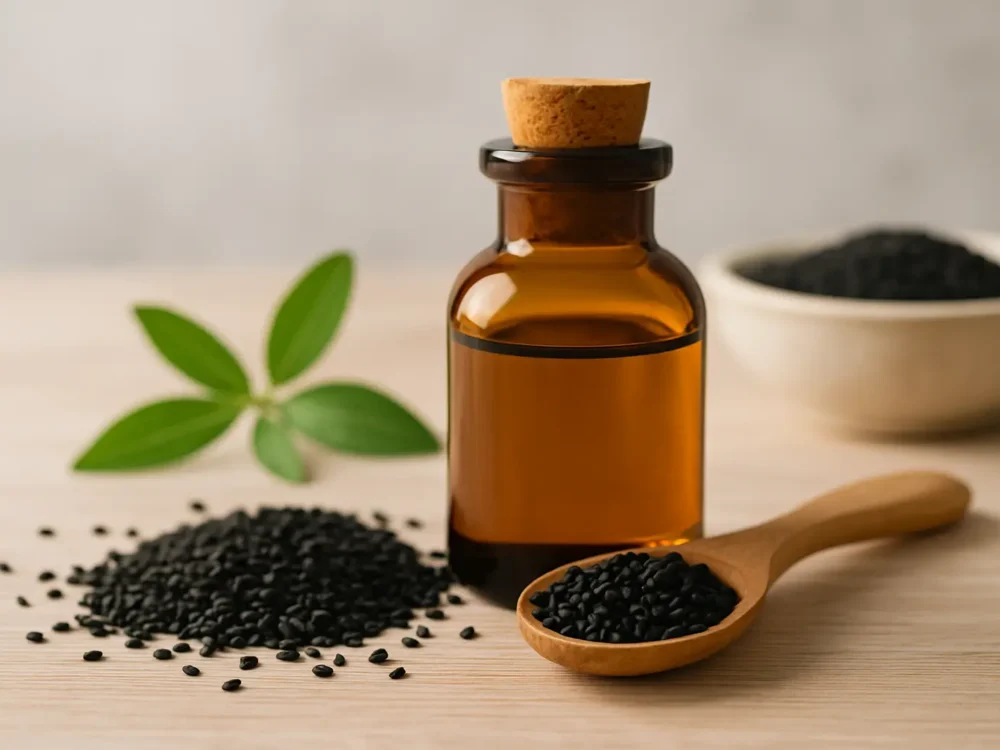
High-quality black seed oil should be protected from light and heat. Dark glass bottles are common for liquids. For softgels, the packaging should still be designed to reduce light exposure and keep the product stable.
If the bottle is clear and it is sitting under bright retail lighting, that is not ideal for an oil where the active compound is sensitive.
Freshness and storage guidance should be specific
A brand that cares about potency usually tells you how to store it and how quickly to use it after opening.
If instructions are vague, you are left guessing. If your climate is hot and humid, storage guidance matters even more. Many shoppers keep oils in a cool cupboard away from sunlight. Some prefer refrigeration for liquids, mainly for freshness and taste.
Liquid vs softgels: which format wins for high TQ routines?
This is where most people get stuck, especially busy professionals who want the benefits without turning the routine into a project.
Liquid black seed oil: flexible dosing, stronger sensory experience
Liquid is the most traditional format, and it gives you full control over serving size. If you are adjusting dose gradually, liquid can be easier.
The trade-off is taste and consistency. Black seed oil has a bold, peppery profile that some people love and others dread. If you buy a bottle and avoid it because the taste is too intense, the best oil in the world is not helping you.
Liquid also requires a little more storage discipline. Opening and closing the bottle repeatedly exposes the oil to oxygen over time. It is not a dealbreaker, but it is a real-world factor.
Softgels: convenience and compliance, especially for travel
Softgels are the “just take it” option. If you want the highest odds of daily consistency, softgels are hard to beat.
They remove taste from the equation and tend to fit better into routines like morning vitamins, gym bags, and work travel. For people who already take electrolytes, collagen, or other capsules, softgels feel like a natural add-on.
The trade-off is less flexibility. You are taking a fixed amount per softgel, so the product has to be formulated well and labeled clearly so you know what you are getting.
How to evaluate high-TQ claims without getting overwhelmed
You do not need to read every study to shop smart. You just need to avoid a few common traps.
First, do not assume “cold-pressed” automatically means “high thymoquinone.” Cold-pressed can be a quality signal, but it is not the same as quantified potency.
Second, watch for vague language like “maximum strength” or “extra potent” with no numbers. Those phrases are marketing, not measurement.
Third, be careful comparing products that use different serving sizes. One brand might list TQ per teaspoon, another per capsule, another per 1 mL. Convert them to a comparable basis so you are not tricked by label formatting.
Finally, remember that high TQ is not the only reason someone chooses black seed oil. Some shoppers are looking for a general wellness staple that fits a clean lifestyle. Others are more performance-oriented and want a precise, repeatable daily dose. The “best” choice depends on your routine style.
Building a routine that actually sticks
Black seed oil works best as a habit, not a heroic one-week sprint.
If you are new, start with a realistic schedule. Many people prefer taking it with food to make it gentler on the stomach. If you are stacking it with other supplements, keep the routine simple at first so you can tell what is working for you.
If your biggest barrier is taste, choose softgels. If your biggest barrier is remembering, keep it near your most reliable daily cue – coffee machine, toothbrush, or your morning water bottle.
And if you are already using hydration products like electrolyte capsules or effervescent tablets, pairing black seed oil with that same daily “wellness moment” can make it feel effortless.
Who should be cautious
Black seed oil is a wellness staple for many, but it is not a one-size-fits-all product.
If you are pregnant, breastfeeding, managing a medical condition, or taking prescription medications, it is smart to check in with a qualified clinician before starting any concentrated botanical supplement. If you have a sensitive stomach, begin with a lower amount and assess tolerance.
Also, if a product is labeled “high thymoquinone,” take that seriously – higher potency can mean you should be more thoughtful, not more aggressive.
Where Sterling-style quality signals matter
For shoppers who want a clean-label, convenience-forward approach to traditional staples, the best brands make it easy to verify what you are buying: clear potency markers, modern formats like softgels, and purity cues that reduce decision fatigue.
That is exactly the lane Sterling Nutrition plays in – remedy-forward essentials designed for daily use, backed by straightforward quality positioning and shopper-friendly formats.
When you are choosing your own high-TQ black seed oil, aim for the product you will take consistently, the label you can understand in 10 seconds, and the potency claim that is actually supported by testing. Your future self will thank you for making “high thymoquinone” something you can trust, not just something you hope is true.